
Remember that sentence.
Because Jessica wasn’t struggling to figure out how to get customers.
Deep down, she already knew.
What she hadn’t figured out was how to get herself to do the very thing she believed would work.
The legend who went quiet
For seventeen years, Jessica Pereira sold to the security industry.
She started in events, selling trade show booth space, then spent a decade at a security industry trade association, where she worked her way up to vice president of sales.
And she was good at it.
By her own account, she sold millions. Booth spaces going for four, ten, twenty, even forty thousand dollars a year. A single email blast to a list of 24,000 security professionals sold for $3,200.
She knew how to sell. She knew the industry.
And maybe most importantly, the industry knew her.
Eventually, she had a realization.
I sold millions for other people. I can just do this for myself.
So she left corporate.
But what followed wasn’t a launch.
It was a year of searching.
She tested offers in industries where she didn’t know anyone. She built a TikTok following to 7,400 people and learned how exhausting content creation could be. She got into cold email and started figuring out that world.
Meanwhile, people from her old industry kept reaching out.
People she’d worked with for years. People who knew her, respected her, and trusted her.
They were texting, asking how she was doing and what she was working on.
And she wasn’t really answering.
Jessica described that period as hibernating.
By the time she sat down with Andrew, though, she had finally figured out what she wanted to build.
She was going back to the industry she knew best: security and life safety manufacturers.
And she wanted to offer something she wished she’d had when she was a VP of sales.
An automated outbound system that could consistently bring sales teams real, verified leads.
She understood the problem because she’d been on the other side of it. Her old employer had spent around $10,000 on lead data that basically just sat there.
She knew companies needed something better.
So Jessica had the experience. The relationships. The reputation. And a pretty clear idea of what she wanted to sell.
There was just one problem.
She hadn’t actually started selling it yet.
A hundred and sixty-two minutes
This wasn’t exactly a quick coaching call.
Jessica and Andrew spent two hours and forty-two minutes working through her business.
And Jessica came prepared.
She had three different packages, a Canva presentation, plans for how she would deliver the service, and a whole list of questions about pricing, contracts, payment terms, purchase orders, and just about everything else that comes with launching an offer.
As she put it, she had "a laundry list of questions."
She also admitted she had way too many tabs open.
Andrew started by telling her that he felt like he was talking to a legend.
And given her background, he meant it.
But as the conversation unfolded, Andrew noticed something important.
On the surface, Jessica had a dozen different problems to solve.
Pricing. Packaging. Contracts. Deliverables. Lead volume.
Any one of those could have consumed an entire strategy session.
But Andrew wasn’t looking at twelve separate problems.
He was looking for the one thing that, if addressed, would make everything else easier.
Jessica didn’t have a sales problem.
She’d spent seventeen years proving she could sell.
What she had was a problem moving from preparation into action.
Because every time they got close to talking about actually launching, another question came up.
How many leads should she promise?
Should a package include 50,000 contacts or 25,000?
What if she couldn’t deliver that number?
What about contracts?
Some of her old clients paid by check. Others needed purchase orders. How was all of that supposed to work?
And to be fair, these were legitimate questions.
They were things she’d eventually need to figure out.
But they were also keeping her from doing the one thing that mattered most.
Getting her first customer.
About forty-eight minutes into the call, Jessica said something that summed up where she was.
“I could literally start this today. I just feel like I’m not, I mean, I’m not ready.”
Jessica · 48:12And when Andrew pushed a little further, she came back with:
“But I do though. I need a contract.”
Jessica · 48:34And there it was.
The difference between knowing what you could do and believing you’re ready to do it.
Maybe you’ve experienced some version of that yourself.
You know what needs to happen. You can practically see the opportunity sitting in front of you.
But there’s always one more thing to figure out before you feel ready.
For Jessica, it was contracts, pricing, and deliverables.
For someone else, it might be hiring the perfect person, launching a new initiative, or waiting until the market feels right.
Different circumstances. Same underlying problem.
Preparation can start to feel like progress, even when it’s the very thing keeping you from moving forward.
"Can I be transparent with you for a minute?"
It wasn’t the first time that hesitation had surfaced.
A few minutes earlier, when Jessica said she just wanted to make sure she had a solid process in place first, Andrew had asked permission to be direct.
Jessica said yes.
“We both know that that’s bullshit. Every process that you’ve ever done, every thing that you’ve ever started, has always started without a clear roadmap to the finish line, right?”
Andrew · 42:10His point wasn’t that contracts or planning didn’t matter.
It was that Jessica was treating every unanswered question like a reason she couldn’t start.
And he wanted her to see the difference.
He told her:
This isn’t you. This is your mind. Your mind is there to protect you.
In other words, her mind was doing what minds do. Looking for reasons to avoid uncertainty.
And when you’re starting something new, there’s always going to be another thing you could prepare for.
So Andrew gave her an example.
Imagine you’re driving from upstate New York to Florida.
You can plan the entire trip. Every stop. Every road. Every tool you might need along the way.
But you’re still going to hit traffic in New Jersey.
You’re still going to deal with Washington, DC.
There might be construction, a road closure, or a detour you had no idea was coming.
You can’t plan for every single thing.
At some point, you have to get in the car and trust that you’ll figure things out along the way.
And here’s what made that conversation important.
Andrew wasn’t asking Jessica to ignore the details or take reckless chances.
He was challenging the assumption that every detail had to be resolved before she could take the next step.
And there was something else he wanted her to recognize.
She’d spent seventeen years making decisions without perfect information.
She’d negotiated deals, managed relationships, and solved problems she couldn’t possibly have anticipated.
Why would starting her own business suddenly require her to have every answer in advance?
She wasn’t a beginner who needed to learn how to become capable.
She was an experienced professional who needed to start trusting the capabilities she’d already developed.
Andrew wasn’t trying to answer every question on her list.
He was questioning whether those answers were actually necessary right now.
Because sometimes the most valuable thing a strategist can give you isn’t another answer.
It’s a better question.
One that changes how you see the entire problem.
And Andrew had one for Jessica.
Who are the three to five people you’re closest to? People you could text right now. Not to sell them. To ask what they think.
Not a marketing campaign.
Not a complicated funnel.
Not another month of preparation.
Three to five conversations with people who already trusted her.
Jessica didn’t even have to think about it.
The first company she mentioned was her old employer.
She already knew exactly who she could call.
Slide thirteen
Then they opened her presentation.
And if you’ve ever spent weeks getting something ready before showing it to a potential client, you’ll probably recognize what Jessica had done.
She’d put everything in there.
Every detail. Every feature. Every part of the offer she thought a buyer might want to know.
Her pricing showed up on slide thirteen.
Andrew stopped her.
He explained that pricing should come at the end of the conversation, after the buyer understands what they’re getting and why it matters.
Jessica wasn’t thrilled.
“You don’t like it. I’m so sad. I love it.”
Jessica · 1:04:52Which is understandable. She’d put a lot of work into the thing.
But Andrew wasn’t telling her this because he had a different opinion about presentations.
He’d learned the lesson the hard way himself.
Earlier in his career, he’d gone into a meeting with senior leadership at one of the largest television broadcasters in the country.
He’d prepared a long presentation full of comparisons, calculations, and details about the cost of what he was offering.
He thought he was being thorough.
He got about four or five slides in before an executive stopped him.
The executive explained that if this had been a one-on-one Zoom call, he would have made up an excuse about another meeting and ended the conversation right there.
The only reason Andrew had gotten that far was because someone had personally helped him get the meeting.
It was a tough lesson.
And one Andrew had carried into the way he thought about persuasion.
More information doesn’t necessarily make a better sales presentation.
Sometimes it just gives people more reasons to lose interest.
And here’s what Andrew recognized about Jessica’s deck.
The real problem wasn’t the number of slides.
It was the conversation those slides were creating.
Jessica had built her presentation around explaining everything her service could do.
Andrew wanted her to think about what a buyer actually needed to understand before deciding to move forward.
What problem were they really trying to solve?
What would solving it mean for their sales team?
Why should they believe this approach would work?
And how could Jessica communicate the value before asking someone to consider the price?
Once those questions were clear, simplifying the presentation became much easier.
So they rebuilt it together during the call, using her existing material, ChatGPT, and a framework Andrew’s team had developed.
But the real work wasn’t moving information around on slides.
It was changing the thinking behind the pitch.
And along the way, Andrew caught something that could have become a much bigger problem later.
Jessica had been using the phrase clone your sales team.
It sounded catchy.
But Andrew asked her to think about what that promise actually meant.
If you tell a company you’re going to clone their sales team, what are they going to expect?
Sales.
Not just leads. Not just better data.
Actual closed deals.
And that wasn’t what Jessica’s service was designed to deliver.
So they shifted the positioning.
Instead of promising to clone a sales team, the service would help empower the sales team.
Better leads. Better information. More time for the conversations that actually close business.
Things Jessica could control.
It was a relatively small change in language.
But Andrew was thinking beyond what sounded compelling in a sales pitch.
He was considering what the promise would cause a customer to expect, how those expectations would affect delivery, and what that could mean for the relationship after the sale.
The goal wasn’t simply to make the offer easier to sell.
It was to make it easier to sell honestly, deliver confidently, and build a business around.
Then Andrew challenged another assumption.
Why launch like a company that had been doing this for ten years?
Jessica already had something more valuable than a polished presentation full of claims.
She had seventeen years of relationships and a reputation she’d earned.
So rather than pretending the service was already established, why not tell those people the truth?
She was building something new.
She believed in what it could do.
And she wanted a small group of founding clients to come in early, at a discounted price, and help her create the first case studies.
It was a more natural approach for Jessica.
She didn’t need to reinvent herself.
She needed to build on who she already was.
And Andrew brought the strategy back to one simple idea.
Sell it first.
Then build out the delivery around the people who actually say yes.
The vow
There’s another moment from the call worth going back to.
Around fifty-seven minutes in, while Jessica was getting her presentation pulled up, Andrew made a prediction.
“I’m going to help you because we’re going to sell one of these by the end of the week.”
Andrew · 57:33He wasn’t talking about spending another month perfecting her deck.
He wanted her talking to customers.
And he believed she could do it.
At the very end of the session, after nearly three hours together, Jessica said:
“I’ll probably reach out to you once I make a sale or something.”
Jessica · 2:41:12Andrew didn’t miss the opportunity.
“You should be reaching out to me by the end of the week then, because you might get on a call with these guys in the next couple of days. I know you can do it. Crush it.”
Andrew · 2:41:16Notice what he didn’t do.
He didn’t give her another twenty things to accomplish.
He didn’t send her away with a complicated implementation roadmap.
He helped her get clear on the next move.
And challenged her to make it.
She reached out after making a sale. In public. By name.
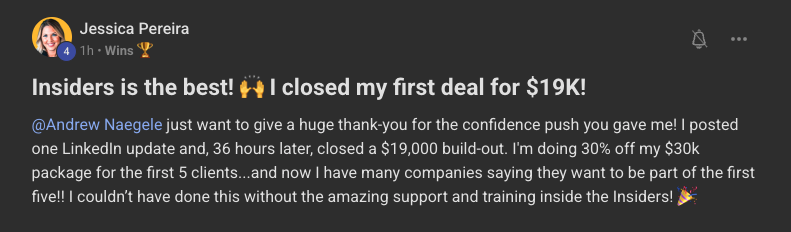
Jessica posted an update in the Insiders community.
And she tagged Andrew.
“@Andrew Naegele just want to give a huge thank-you for the confidence push you gave me! I posted one LinkedIn update and, 36 hours later, closed a $19,000 build-out.”
Jessica’s postOne LinkedIn post.
Thirty-six hours.
A $19,000 deal.
Now think back to what Jessica said just sixteen minutes into the strategy session.
Honestly, like if I make one post on LinkedIn, I’ll probably get a ton of calls.
She’d practically predicted it.
She had the relationships. She had the reputation. She knew people in the industry trusted her.
She just needed to put herself back out there.
And after spending so much time trying to get everything ready, that’s exactly what she did.
She made one post.
And she closed her first deal.
She also kept her word about reaching out to Andrew when she made a sale.
Except instead of sending him a private message, she thanked him publicly.
“If I make one post on LinkedIn, I’ll probably get a ton of calls.”
“I posted one LinkedIn update and, 36 hours later, closed a $19,000 build-out.”
The nineteen thousand was the opening move
There’s another part of Jessica’s update that’s easy to overlook if you only focus on the $19,000.
She wrote:
“I’m doing 30% off my $30k package for the first 5 clients... and now I have many companies saying they want to be part of the first five!!”
Jessica’s postLook at the change.
During the strategy session, Jessica had been trying to figure out how to package everything, how to price it, what to promise, and how to get started.
Now she had a $30,000 package.
A 30% founding-client discount.
A first paying client.
And according to her update, multiple companies expressing interest in joining that founding group.
It was almost exactly the approach Andrew had walked her through on the call.
Start with the people who trust you.
Give them a reason to come in early.
Be honest about what you’re building.
And get the first clients in the door.
The same woman who’d spent a year hibernating was suddenly hearing from companies that wanted to work with her.
And instead of wondering how to get her first customer, she was now looking at who might fill those first five spots.
Those spots didn’t stay open for long.
Five more deals followed that first $19,000.
All told, the offer she’d spent a year getting ready to launch brought in more than $100,000.
Would she have gotten there eventually on her own? Probably. She had everything she needed.
Andrew helped her get there now.
One session. What changed.
It’s worth looking at the sequence.
- Roughly a year spent exploring, preparing, and trying to get everything figured out.
- Seventeen years of industry relationships and proven sales experience.
- Three packages, a presentation, and a long list of unanswered questions.
- No first client for the new offer.
- One 162-minute strategy session, the first of several.
- A challenge to the assumptions keeping her from launching.
- A clearer offer and a more compelling, deliverable promise.
- A founding-client strategy built around relationships she already had.
- One immediate challenge: stop waiting for perfect conditions and start having conversations.
- One LinkedIn update.
- A reported $19,000 build-out closed 36 hours later.
- A $30,000 package with a 30% founding-client discount.
- Multiple additional companies expressing interest in the first five spots.
- Five more deals after that, and more than $100,000 in total.
No year-long consulting engagement.
No massive marketing campaign.
No elaborate business overhaul.
One strategy session, the first of several, that helped a highly experienced professional see her business differently, make a few better decisions, and act.
And to be clear, Jessica did the selling.
She brought the seventeen years of experience, the relationships, the credibility, and the ability to deliver.
Andrew didn’t create those advantages.
He helped her recognize them, organize them into a strategy, and finally put them to work.
What this story is really about
The interesting thing about Jessica’s story is that she didn’t suddenly learn how to sell during a two-hour-and-forty-two-minute coaching call.
She already knew how.
She’d spent seventeen years doing it.
She didn’t need someone to go find her a market.
She had one.
She didn’t need someone to build her a reputation.
She’d already earned it.
And she wasn’t struggling because she lacked ambition or a business idea.
She had both.
What was holding her back was the belief that she needed everything figured out before she could begin.
The contracts.
The pricing.
The number of leads.
The presentation.
All of those things mattered.
But they didn’t all need to be solved before she could take her first meaningful step.
That’s where Andrew made the difference.
Not by giving Jessica some secret sales technique she’d never heard of.
Not by building her a complicated new system.
And certainly not by doing the work for her.
He saw a constraint that was difficult for her to see while she was in the middle of it.
He challenged the assumptions slowing her down, helped her think differently about the buying decision, tightened the offer, and gave her a clear direction for what to do next.
Then Jessica did what she’d always been capable of doing.
She sold.
And suddenly, the business she’d spent a year thinking about was a business with a paying client.
That’s what makes this story worth remembering.
Jessica wasn’t inexperienced. She wasn’t someone who needed to be taught everything from scratch.
She was an accomplished sales professional with millions in sales behind her.
And even she benefited from having someone outside the business ask different questions and help her see the path forward.
Because when you’re inside your own business, it’s surprisingly easy to confuse activity with progress, preparation with necessity, and the next thing you could do with the one thing that would actually move you forward.
Sometimes the greatest value another person brings to your business isn’t doing something you can’t do.
It’s helping you see something you couldn’t see on your own.
Jessica had spent nearly a year preparing.
Andrew spent 162 minutes helping her question what she was preparing for.
And thirty-six hours after one LinkedIn post, she had closed a $19,000 deal.
By the end, she’d passed $100,000.
The extraordinary part?
She’d predicted the opportunity sixteen minutes into their conversation.
Sometimes the thing standing between you and your next chapter isn’t what you still need to learn.
It’s what you already know, but haven’t acted on yet.
About the sources for this story
- Every quote with a timestamp comes from the recorded 162-minute strategy session.
- The result and the “first five” update are quoted from Jessica’s own post, shown above unedited.