
The man who saw the future twice
Jon Benson is widely credited with inventing the video sales letter, a format that transformed direct-response marketing and went on to generate billions in sales.
But copywriting wasn’t the only thing Jon was ahead of the curve on.
While most marketers were still thinking about AI as something out of a science-fiction movie, Jon was already exploring how technology could automate and improve persuasive writing.
He’d been developing copywriting software for well over a decade and working with early AI years before ChatGPT became a household name.
He wasn’t simply watching the future unfold.
He was helping build it.
And when Andrew first got started online about twelve years earlier, Jon was already one of the people he measured himself against.
Someone whose thinking he respected.
Someone he wanted to learn from.
So Andrew bought Jon’s AI copywriting software, BNSN. He joined the community and started using the tools.
And when Jon eventually released a course teaching his approach to copywriting, Andrew signed up for that too.
The course cost roughly five or six thousand dollars.
Andrew paid it "with no clear ROI," as he later described it.
He wasn’t selling copywriting services.
He didn’t have some elaborate plan to turn the course into a new business.
He just wanted to understand how one of the best in the industry thought about persuasion.
And that distinction matters.
Andrew wasn’t simply interested in learning which words Jon used.
He wanted to understand the thinking behind them.
He had no idea that curiosity would eventually lead Jon to ask him to work on his own software.
The spreadsheet
About six weeks into the course, Jon showed the class how he edited copy.
Not with expensive software.
With a Google Sheet.
It was filled with formulas for counting words, syllables, verbs, adjectives, and NLP phrases.
All the little details Jon considered when improving a piece of writing.
Andrew watched the demonstration and had a thought.
I could turn that into software.
Not because Jon had asked him to.
Not because Andrew was trying to start a software company.
He simply recognized that a useful process could become something easier to use.
So he opened Lovable, an AI app builder he’d been experimenting with.
And he started building.
For three days, he went down the rabbit hole.
By the end of it, he’d created a working tool based on Jon’s spreadsheet.
He called it Copy Tuner.
A little music reference he figured Jon would appreciate.
Andrew recorded a walkthrough, and during one of the community’s Friday calls, the conversation happened to turn toward Lovable.
So he showed everyone what he’d made.
He was careful to explain that the thinking behind the tool belonged to Jon.
He wasn’t planning to sell it.
He’d simply seen something that could be improved, imagined what it might become, and built a working example.
And that got Jon’s attention.
The message
Then the message came.
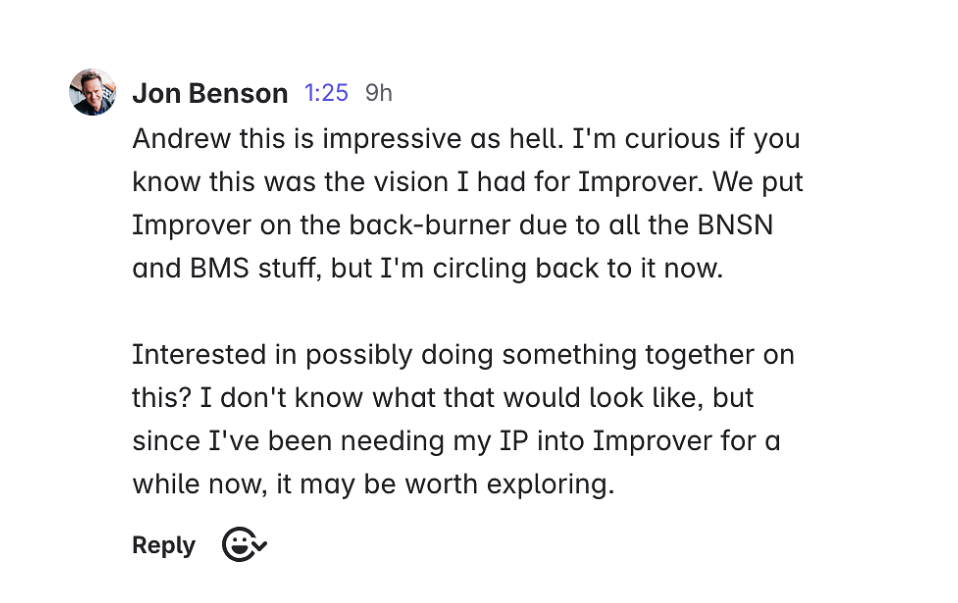
“Andrew this is impressive as hell. I’m curious if you know this was the vision I had for Improver... Interested in possibly doing something together on this?”
Jon Benson’s messageRead that again.
This was the vision I had.
Without knowing it, Andrew had created something remarkably close to a product Jon had already envisioned.
And now the person Andrew had admired for more than a decade was asking whether they could work together.
Soon after, they got on a call.
Jon explained that his existing software, BNSN, needed a complete redesign.
He wanted an experience that felt "almost like an Apple-like experience."
Clean. Simple. Intuitive.
But Jon had a problem.
He’d been so deeply involved in the product for so long that it was becoming difficult to see it with fresh eyes.
In his words, he was "too close to the forest to see the tree."
And that’s where Andrew became interesting.
Jon already had developers.
He knew Andrew wasn’t an experienced coder.
What he wanted was someone who understood the product as a user. Someone familiar with the new AI tools. Someone with a strong eye for design who could look at the experience differently.
And here’s what made that especially meaningful.
Jon wasn’t some business owner who’d just discovered AI and needed someone to explain it to him.
He’d been working with emerging technology for years.
He understood what was coming.
And when Andrew showed him something he’d created with a new generation of AI tools, Jon recognized the possibilities immediately.
Not just the application itself.
The thinking behind it.
That’s what led him to invite Andrew into the project.
And Andrew had already demonstrated that ability.
At a time when AI app builders like Lovable were just beginning to change what non-developers could create, Andrew was already experimenting with what was possible.
He’d seen a spreadsheet and imagined an application.
Jon had seen the application and recognized the kind of thinking he wanted involved in his own product.
He also wanted to move quickly.
“When somebody says, okay, we can have this done in two weeks, that’s two months, man. Two weeks in A.I. time is two months.”
Jon Benson · their first callDuring their conversation, Jon mentioned that a Vancouver team had quoted him $7,500 for 21 days of work on a similar project for another product.
Then he asked Andrew what he’d charge.
Andrew was upfront.
“As fanboy as this sounds, the opportunity to work closer with you and the team... would be huge for me. So in terms of a rate, I would be flexible... I haven’t done enough of the contract work in that realm to be able to say I know that this is a fair rate.”
Andrew · their first callHe wasn’t pretending to have a decade of experience doing software redesigns.
He told Jon the truth.
Jon said he’d come back with what he thought the work was worth.
And when he did, it was five times what Andrew had planned to charge.
Five times.
Andrew was valuing the opportunity through the lens of his limited experience doing that particular kind of work.
Jon was valuing something he’d already seen.
The ability to recognize an opportunity.
Think beyond an existing process.
And turn an idea into something tangible.
His idol had recognized value in him that Andrew hadn’t fully recognized in himself.
It was one of the highest points of his working life.
And it lasted until he opened the code.
The code
On that first call, two details had seemed straightforward.
Andrew had told Jon:
I’m not a coder, but I’ve picked these up pretty fast.
And Jon had told Andrew he wouldn’t need to do any coding.
So Andrew reached for the tool he knew.
I could Lovable that.
He figured he could take Jon’s existing codebase, bring it into Lovable, and use AI to redesign the application.
There was just one problem.
That’s not how Lovable worked.
Lovable could help Andrew create entirely new applications. But BNSN wasn’t a new application.
It was a real, working product with real users, an established codebase, its own developers, and years of history.
And Andrew had badly underestimated what it would take to work inside that environment.
He’d never used GitHub.
What the hell is Git?
What’s a repository? A worktree?
Why are there branches? What are all these extensions?
And what the hell is Prettier?
The only Python he knew was a snake.
And when someone started talking about running the application locally, the only local he was familiar with was the grocery store.
He wasn’t just unfamiliar with the answers.
He didn’t even understand half the questions.
With step-by-step help from Jon’s developer, Ted, and a process that stretched across two days, including a Zoom call and hours of troubleshooting, Andrew finally got the code and Supabase environment onto his machine.
And that was just the beginning.
Then came the database.
The dependencies.
The scripts.
The errors that might as well have been written in another language.
At one point, staring at everything in front of him, Andrew had one thought:
This is all Greek.
But even that doesn’t quite describe what it felt like.
Imagine being dropped into the middle of a desert.
No water. No map. No idea which direction leads home.
Except that would imply you at least understood what a desert was.
Andrew didn’t even know what the sand was.
He didn’t understand the heat, the terrain, or how quickly things could go wrong.
Just days earlier, this had looked like the opportunity of a lifetime.
His hero had personally reached out.
He’d offered five times what Andrew expected.
Andrew could practically see himself delivering an incredible project, earning Jon’s respect, and proving what he was capable of.
But that beautiful picture was vanishing fast.
The glorious proving ground he’d imagined was beginning to look more like a nightmare.
This wasn’t a little outside his comfort zone.
This was hell.
And it was getting hotter by the minute.
Then came the panic.
“So now I’m panicking. I just told my hero I can do this.”
Andrew, retelling it laterHe’d said yes because he genuinely believed he knew how to approach the project.
He hadn’t lied about his experience.
He hadn’t pretended to be a developer.
But he’d overestimated what he could accomplish with the tools he knew.
And suddenly, the gap between what he’d promised and what he knew how to deliver felt enormous.
The very person who had recognized something valuable in the way Andrew thought was now the person Andrew was terrified of disappointing.
Going dark
Andrew went dark.
But not in the inspiring, disciplined, I’m going to disappear for two weeks and come back unstoppable kind of way.
Not at first.
At first, he disappeared because he was terrified.
Ashamed.
Angry with himself.
He’d been given an opportunity most people in his industry would dream of.
Jon Benson. His idol. The man whose work he’d studied for twelve years.
And Andrew was beginning to believe he’d blown it before he’d even started.
In his mind, this was what career suicide looked like.
He could already imagine having to face Jon and explain that the guy Jon had trusted with his product couldn’t deliver.
And that thought was crushing.
He was lost. Frustrated. Sad. Scared.
For the first day or two, he wasn’t confidently building his way out of anything.
He was sitting with the fear.
Wondering how he’d gotten himself into this position.
And what the hell he was going to do.
He wanted to hide.
And for a little while, that’s exactly what he did.
But somewhere in those first couple of days, something began to change.
He thought about Jon.
About the trust he’d placed in him.
About what it would mean to walk away without giving the opportunity everything he had.
And he came back to something he knew about himself.
He might not know how to do the work.
He might have underestimated the challenge.
He might have made one hell of a mistake.
But he’d never let someone down without a fight.
And he wasn’t about to start now.
So he made a decision.
He was going to figure it out.
Not because he suddenly felt confident.
Not because the fear disappeared.
But because he wasn’t willing to let the fear make the decision for him.
So Andrew turned to an incredible, seemingly infinite source of knowledge.
A place where practically any question could be answered.
Where experts from around the world shared everything they knew.
No, not AI.
Well, eventually AI.
First?
YouTube.
Coding for beginners.
GitHub tutorials.
How to run an application locally.
How to work with repositories.
How to connect a database.
Basically, coding for dummies.
Coding for guys who thought Python was a snake.
Coding for people who’d enthusiastically said yes to something they now realized they had absolutely no idea how to do.
One video became another.
One unfamiliar term led to five more.
Every answer uncovered another question.
And down the rabbit hole he went.
Truthfully, Alice had nothing on him.
But something important was happening.
The more he learned, the more this unfamiliar world began to make sense.
Ted helped him navigate the existing application. The codebase had its own challenges; Jon described some releases arriving with "like 700 like conflicts" after rapid changes by the development team.
Andrew began using AI to help him work through the technical problems.
But he quickly discovered that throwing a hundred prompts at an established application wasn’t going to magically produce the result he wanted.
He needed something more fundamental.
A plan.
What needed to change?
How did the pieces fit together?
What would a better experience look like for the person actually using the product?
And how could he make those changes without breaking everything around them?
He started mapping the application.
Studying how users moved through it.
Breaking the work into smaller problems.
Writing detailed implementation instructions.
Thinking through each step before asking the tools to execute it.
He didn’t know the terrain.
So he started making a map.
And slowly, the things that had seemed impossible started becoming problems he could understand.
Then problems he could work through.
Later, Andrew described that period in one sentence:
“I closed out the whole world for two weeks, and went as deep as I possibly could.”
Andrew, retelling it laterBut those two weeks hadn’t started with confidence.
They’d started with fear.
The decision to keep going came afterward.
And that distinction matters.
Because the breakthrough wasn’t that Andrew discovered he was secretly an experienced developer.
He wasn’t.
It was that he stopped expecting himself to already know everything and started figuring out what he needed to learn.
He’d accepted the project because he could see what was possible.
Now he was learning what it would actually take to make that possibility real.
The call, again
Which brings us back to the call.
Andrew was walking Jon through what he’d built.
And Jon opened with something Andrew probably wasn’t expecting.
“I just want to make sure that hopefully we’re on the same page. It’s like I wasn’t asking for any sort of like coding or anything like that... So I appreciate you going the extra mile... the main thing was... kind of like a glorified Figma.”
Jon Benson · reviewing the redesignJon had only asked for the design.
Something his developers could use as a guide.
Andrew had pushed himself into the code because he’d wanted to explore how to bring that vision to life.
And that effort had taken him far beyond what the original brief required.
In the middle of the walkthrough, he’d admitted how frightened he’d been that he couldn’t deliver.
Then they continued through the screens.
And Jon started giving feedback.
“What you have there is, is really good.”
Jon · reviewing the redesignThen:
“I think this is much cooler and better looking, but requires a little bit more work, too. So I think it’s worth the work, personally.”
Jon · reviewing the redesignAnd:
“I love the look of it.”
Jon · reviewing the redesignFinally:
“As far as the general layout goes, I really like it, and the general look is great... this is really close.”
Jon · reviewing the redesignThink about the difference.
A couple of weeks earlier, Andrew had been staring at unfamiliar code, wondering if he’d made the biggest professional mistake of his life.
Now he was walking Jon Benson through a redesign Jon genuinely liked.
There was still work to be done.
Jon said so himself.
But he liked the direction.
He thought the additional work was worthwhile.
And he could see how close they were getting.
A few weeks later, Andrew reflected on the experience.
“My biggest holdup, Jon, was the fact that I didn’t know how the hell to code... I spent many nights figuring out exactly how to do that. But now I’m doing really well with it and I love it.”
Andrew · a few weeks laterThe man who’d been panicking over a codebase was now enjoying the challenge.
And Jon’s next words were about moving toward release.
"Our goal is to try to get this live this week."
They weren’t discussing whether Andrew could figure out the project anymore.
They were discussing getting the redesign into the product.
His name on it
More than a year later, Andrew was teaching a team how to use AI.
And during that training, he pulled up BNSN on screen.
Not the old version he’d first encountered.
The redesigned experience he’d helped create.
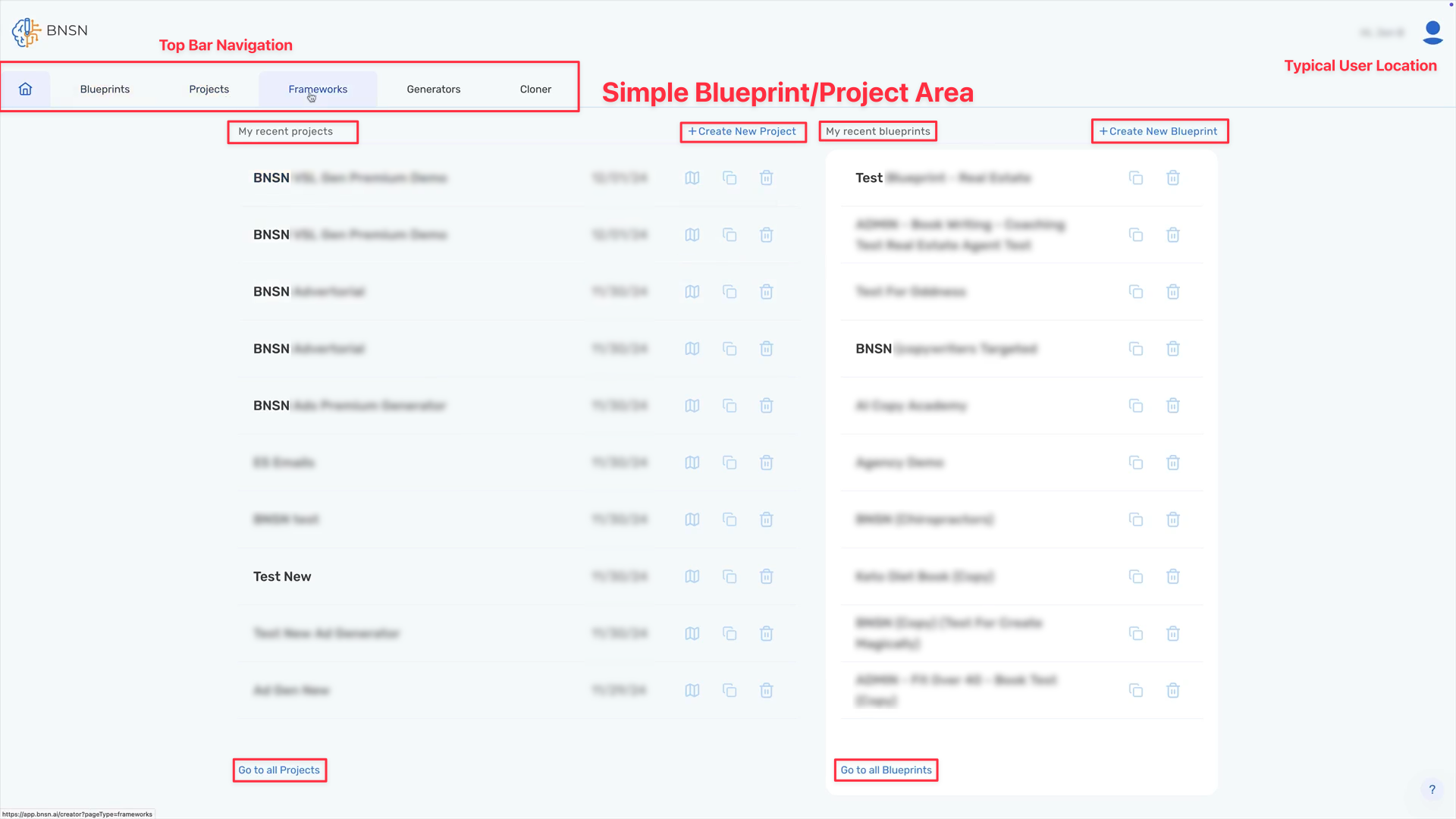
The new look. The rounded interface. The visual direction and branding work he’d poured himself into.
He looked at it and said:
“It didn’t used to look like this. This whole rounded theme and everything, this was me, but I had never done this before. This is not something I knew how to do.”
Andrew, teaching a teamThere’s something special about that moment.
Because this wasn’t just another project in Andrew’s portfolio.
This was Jon Benson.
The man whose work he’d followed for twelve years.
The person whose ideas he’d studied, whose courses he’d purchased, and whose opinion he’d valued long before they ever spoke.
And now Andrew could look at a product bearing Jon’s name and see work he’d contributed to.
The redesign. The rebrand. The countless decisions about how the experience should look, feel, and work.
Something that had begun as a little experiment with a spreadsheet had become an opportunity to help shape the next chapter of a product created by one of his heroes.
And remember where this story nearly ended.
With Andrew staring at a codebase he didn’t understand.
Terrified he’d made the biggest mistake of his career.
Wondering how he’d ever face Jon if he failed.
Now, more than a year later, he was pointing to that same project while teaching other people what was possible.
He’d developed new capabilities.
He’d learned a fundamentally different way to build.
He’d had the opportunity to collaborate with someone he’d admired for over a decade.
And he’d helped create something he was genuinely proud to put his name on.
Not because everything had gone perfectly.
It hadn’t.
Not because he’d known exactly what he was doing from the beginning.
He certainly hadn’t.
But because he’d encountered something that frightened him, admitted how far out of his depth he was, and found a way to grow into the responsibility he’d accepted.
On stage in Miami, Andrew put it simply.
Jon Benson "hired me to do something that I didn’t have any experience with."
And Andrew used AI to help figure out how to build the interface.
Those two weeks when he’d shut out the world were where he said he "caught the bug."
But perhaps what he’d really discovered was something he’d carry into every challenge that came afterward.
You don’t always have to know how to do something before you can recognize what’s possible.
You do, however, have to be willing to do the work required to make it real.
And this time, he’d done exactly that.
One project. What changed.
It’s worth looking at the sequence.
- Andrew had spent roughly twelve years following and learning from Jon’s work.
- He was a user of Jon’s software and a student in his copywriting course.
- He had experience experimenting with new AI development tools, but not working inside an established codebase like BNSN.
- He independently turned Jon’s spreadsheet-based editing process into a working application.
- Jon saw Copy Tuner and called it "impressive as hell."
- Andrew had built something close to a product Jon had envisioned.
- Jon wanted fresh thinking, design judgment, and someone who understood the product as a user.
- He offered Andrew five times what Andrew expected to charge.
- Andrew discovered he’d misunderstood the project’s technical demands and the limits of his existing tools.
- He spent roughly two intensive weeks learning, planning, and working through those challenges.
- Jon reviewed the redesign and praised its look, layout, and direction.
- Within weeks, Jon was discussing a goal of getting the redesign live that week.
- The redesign and rebrand went live. More than a year later, Andrew could pull up BNSN and point to the rounded interface he’d created.
The significance of the engagement is clear.
Jon recognized something valuable in Andrew’s thinking before Andrew had the technical experience the project would eventually demand.
And Andrew worked to justify that trust.
What this story is really about
Jon Benson had access to developers.
He knew Andrew wasn’t an experienced coder.
And he certainly didn’t need someone to explain the potential of artificial intelligence to him.
He’d been exploring it for years.
What caught Jon’s attention was something else.
Andrew had looked at an ordinary spreadsheet, recognized what it could become, and built something Jon hadn’t asked him to build.
And Jon saw enough value in that thinking to invite Andrew into his business.
The technical challenge came afterward.
And Andrew’s response to it wasn’t perfect.
He underestimated the work. He got scared. He wanted to hide.
But he didn’t stay there.
He learned, adapted, asked for help, and eventually produced work he could stand behind.
That’s what makes this story worth remembering.
Because great opportunities don’t always arrive after you’re fully prepared for them.
Sometimes someone recognizes something in you before you’ve fully recognized it yourself.
And sometimes the responsibility that comes with being trusted forces you to become capable of things you never imagined doing.
Twelve years earlier, Andrew was looking up to Jon Benson, wondering how someone could think the way he did.
Now he’d had the opportunity to work alongside him, help shape his software, and contribute something of his own.
He’d started the journey hoping to earn his hero’s respect.
And somewhere along the way, he earned something else.
His own.
About the sources for this story
- Quotes come from recorded calls between Andrew and Jon Benson.
- Jon’s message is shown above unedited.
- The amount Jon paid is under NDA and is not stated.